
Table of Contents
Introduction
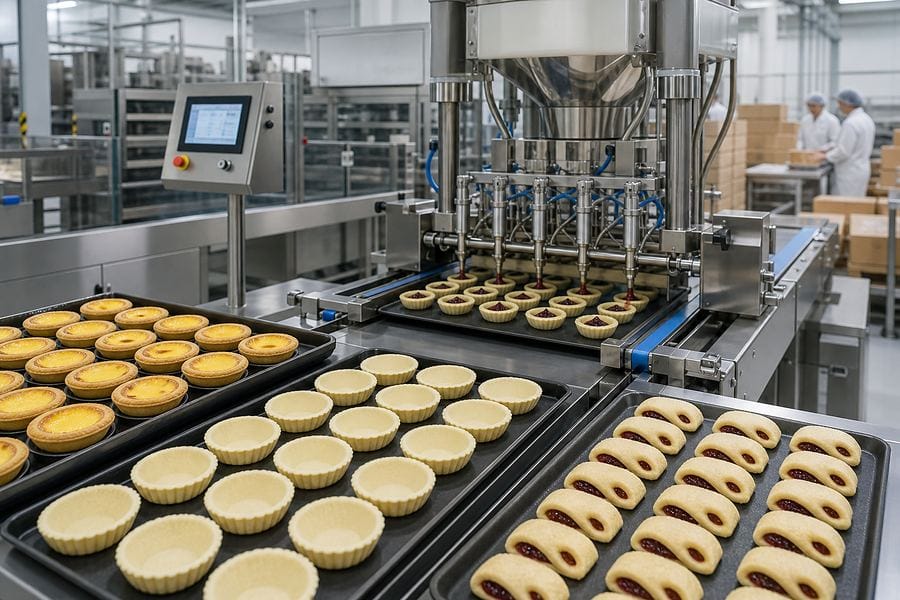
Bread production becomes increasingly difficult to control when every stage depends on separate manual operations. Dough may be divided inconsistently, forming pressure can vary between operators, transfer between stations may interrupt production rhythm, and changes introduced early in the process can affect the appearance of the finished bread.
A bread production line organizes these individual operations into a connected workflow. Depending on the type of bread being produced, the process may involve dough dividing, thickness reduction, forming, filling, conveying, portion control, and preparation for downstream proofing or baking.
The purpose of a production line is not simply to make each individual machine operate faster. The real objective is to make material move predictably from one processing stage to the next while maintaining consistent dough condition, dimensions, spacing, and production rhythm.
Because bread varieties differ significantly in shape, dough formulation, filling method, and forming requirements, there is no single machine configuration that represents every bread production line. Effective line design begins with the bread itself and works backward through the required processing stages.
What Is a Bread Production Line?
A bread production line is a coordinated sequence of processing equipment that moves dough through several production stages before the product reaches proofing, baking, packaging, or another downstream operation.
The basic concept follows the broader principle of a production line, in which different operations are arranged in sequence so that material progresses through a defined manufacturing process.
For bread production, the exact configuration depends on the product. A soft filled bun may require dividing, rolling, filling, sealing, and shaping. A loaf may require dividing, preliminary forming, rolling, and final molding. Other products may require cutting or specialized forming before they continue downstream.
A typical process may look like:
Dough preparation → dividing → rolling or flattening → forming → optional filling → conveying → downstream proofing and baking
Not every factory needs all of these stages to be automated. The appropriate configuration depends on which operations create the greatest variation or production bottlenecks.
Why Bread Type Should Determine the Line Design
One of the most important principles in planning a bread production line is to begin with the finished product rather than the machinery.
Bread products that appear similar can behave very differently during production. A soft bun dough may need gentle handling to preserve its structure, while a firmer dough intended for rolled products may tolerate more mechanical forming.
Product geometry also changes equipment requirements.
Round buns require a different forming process from elongated bread. Filled products need controlled filling and sealing. Rolled bread may require the dough to be flattened before being curled into its final shape.
Several product characteristics should therefore be defined before the production process is designed:
- Finished bread dimensions
- Dough piece weight
- Dough softness and elasticity
- Required shape
- Whether filling is used
- Surface and internal structure requirements
- Production sequence after forming
These characteristics determine which operations need to be included and how closely individual machines must work together.
How Dough Processing Starts the Production Flow
A stable bread production line depends heavily on the condition of the dough entering the first automated processing stage.
Dough is not a rigid material. Its behavior can change with formulation, hydration, mixing development, resting time, temperature, and handling history. Two dough batches with the same nominal weight may behave differently if one is warmer or more elastic than the other.
Before forming begins, the dough often needs to be converted into controlled portions or dimensions.
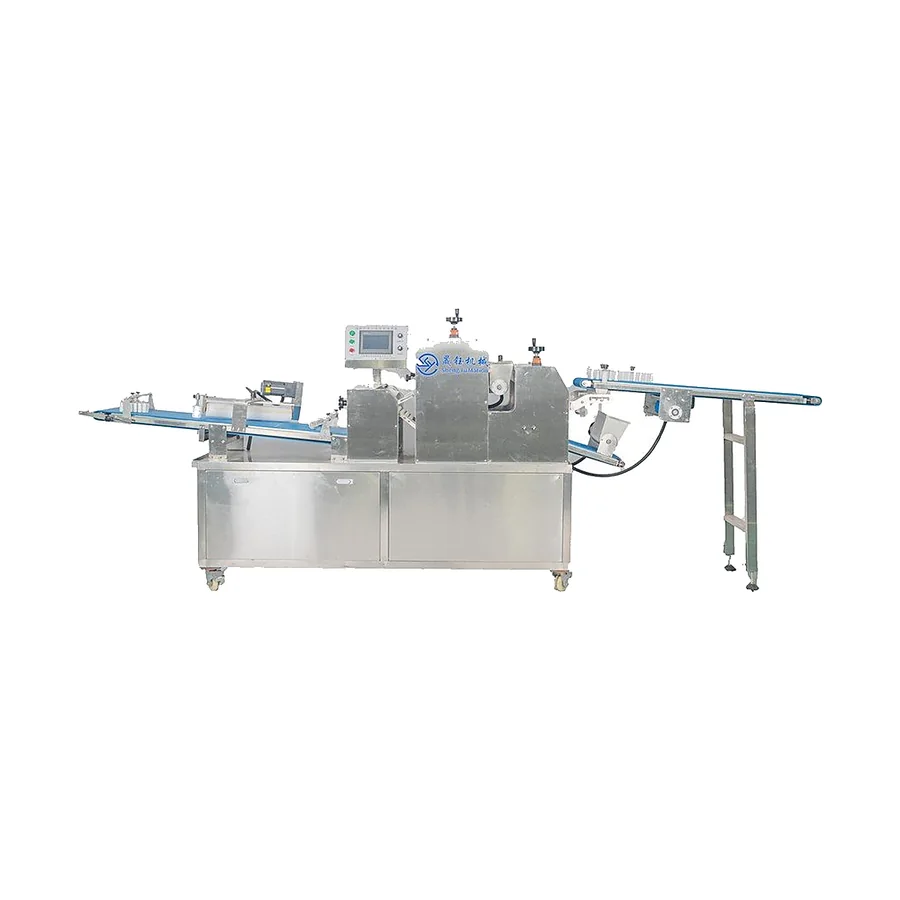
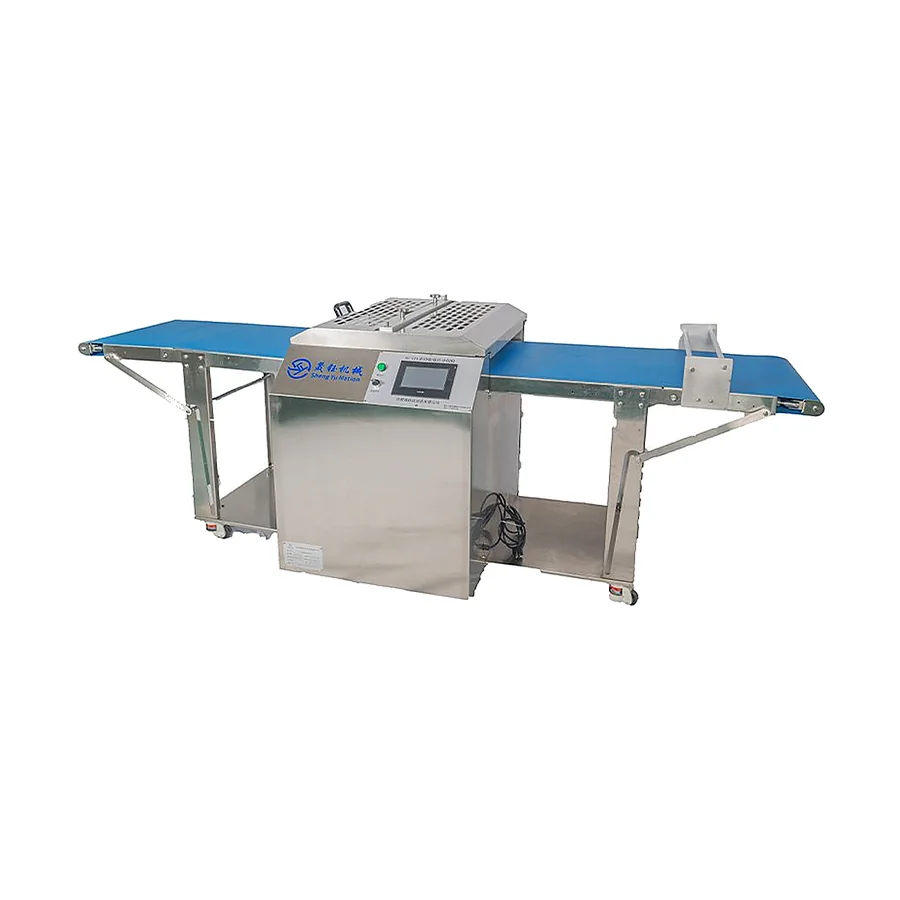
Equipment within ShengYu’s dough processing machine range can support operations such as dividing, rolling, sheet preparation, cutting, or preliminary forming where these processes are required by the product.
The goal of this stage is to provide the following machine with dough that falls within a predictable range.
If the incoming dough pieces vary significantly in weight or dimensions, downstream forming equipment must process inconsistent material. That makes product consistency harder to achieve even when the forming machine itself operates repeatably.
Why Dough Dividing Matters
Dividing determines how much dough enters each individual product.
For bread produced as separate pieces, portion variation at this stage can continue through the rest of the production process. A forming machine can shape two dough pieces in the same way, but if one contains substantially more dough, their final dimensions may still differ.
Consistent dividing is particularly important when products later enter fixed forming tools or molds.
However, dividing accuracy should not be considered in isolation. Dough density and gas structure can influence volumetric behavior, while dough sticking or irregular feeding can affect how material reaches the dividing section.
The dividing stage should therefore receive dough in a reasonably stable condition and deliver portions that the next operation can process without excessive manual correction.
When designing a bread production line, manufacturers should consider both portion accuracy and how divided dough is transferred toward the next stage.
How Rolling and Flattening Prepare Dough for Forming
Some bread products require dough pieces to be flattened before they can be rolled, filled, or molded into their final form.
Rollers apply controlled pressure to the dough and gradually reduce its thickness. This creates a more predictable shape before the next operation.
The amount of thickness reduction depends on the product. Excessive compression can create unnecessary stress, while insufficient reduction may leave the dough too thick for the intended forming method.
Progressive rolling can help control this process.
Instead of forcing a thick dough portion immediately to its final thickness, the dough can pass through controlled reduction stages. This allows operators to observe whether the dough stretches smoothly, tears, shrinks, or develops uneven edges.
Dough temperature and elasticity are important at this stage. Elastic dough may partially recover after leaving the rollers, so the machine setting should be evaluated according to the stabilized dough rather than only the physical roller gap.
How Bread Forming Machines Shape the Final Product
Once dough portions reach suitable dimensions, forming equipment can create the product’s intended shape.
Bread forming may involve rolling, curling, elongating, pressing, molding, or a combination of several movements. The correct method depends on the dough and desired finished geometry.
For example, a dough piece intended for a rolled product may first be flattened and then curled. An elongated product may need gradual shaping to achieve length without damaging the dough structure.
A good forming process controls pressure rather than simply applying as much force as possible.
If pressure is too aggressive, dough can tear or lose desirable internal characteristics. If pressure is too low, the product may not maintain its intended shape.
The wider Bread Production Equipment category should therefore be considered according to the specific forming stages required by each bread product rather than assuming every bread follows the same mechanical process.
Where Filling Fits Into a Bread Production Line
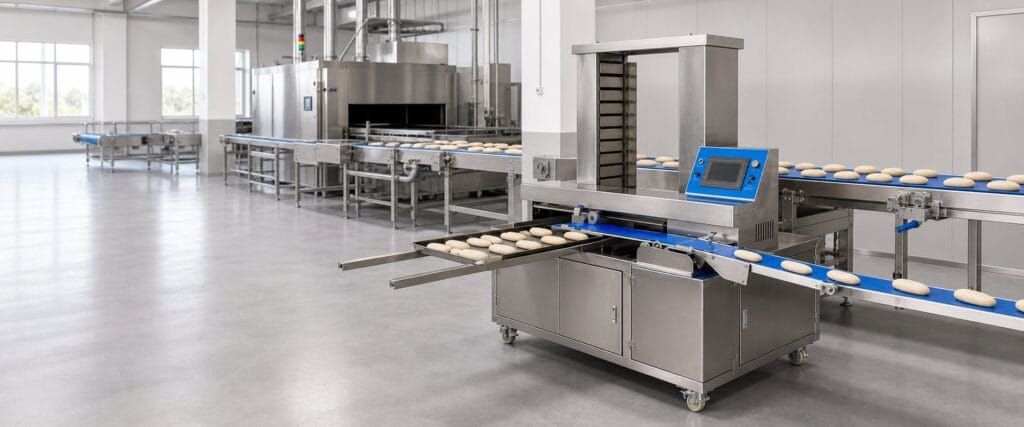
Filling is required only for certain bread products, but when it is included, its position within the production sequence needs careful planning.
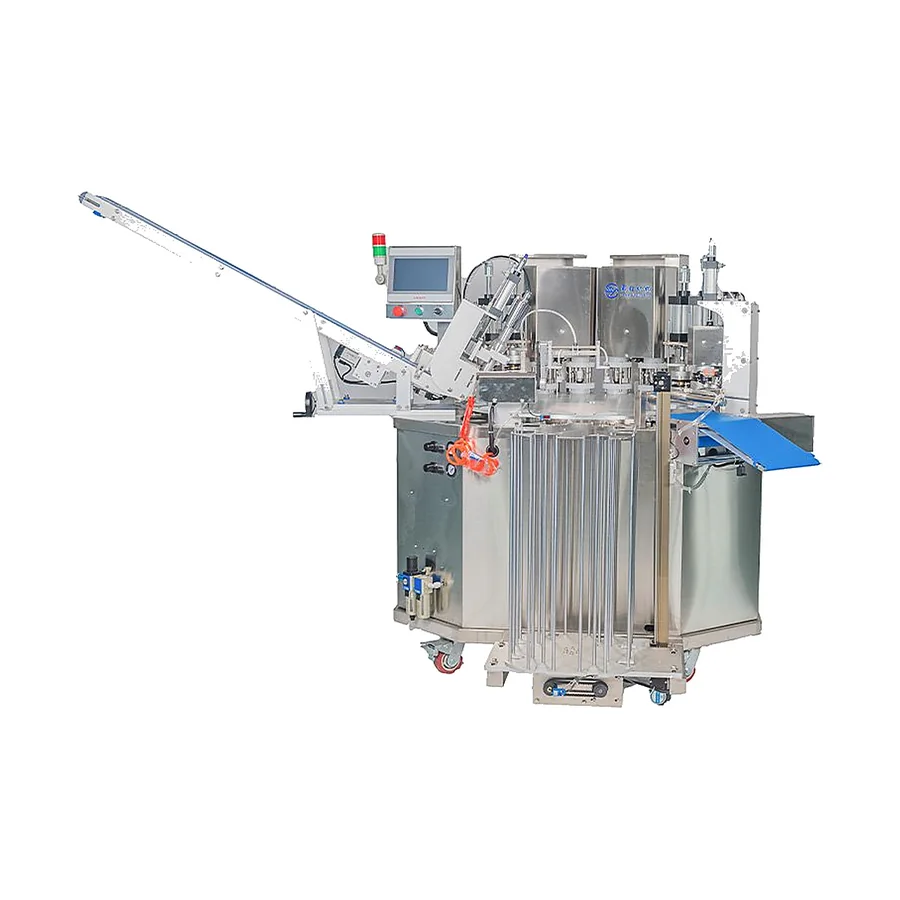
The dough normally needs to reach a suitable shape before filling is deposited. Depending on the product, it may then be folded, rolled, enclosed, or sealed around the filling.
Several factors influence filling performance.
The filling must have suitable flow characteristics for controlled depositing. Its portion should also match the quantity of dough surrounding it. Excess filling can interfere with sealing, while insufficient filling may affect product consistency.
Positioning matters as well. If the filling is deposited too close to an edge, later forming operations may push it out of the dough.
The timing between dough arrival and filling deposition must therefore remain synchronized.
For a continuous bread production line, filling should be treated as part of the forming process rather than as an unrelated machine positioned between two conveyors.
How Equipment Capacity Should Be Balanced
A production line is only as stable as the relationship between its connected stages.
Consider a line in which one machine can process dough much faster than the next forming stage. Increasing the speed of the first machine will not necessarily increase total output. Instead, dough may begin accumulating before the slower machine.
The same problem can occur further downstream.
| Stage | Main Process Variable | Risk When Poorly Matched |
|---|---|---|
| Dough feeding | Supply consistency | Interrupted processing |
| Dividing | Portion and timing | Irregular product size |
| Rolling | Thickness and speed | Uneven dough preparation |
| Forming | Shape and cycle rate | Product accumulation |
| Filling | Portion and timing | Inconsistent filled products |
| Transfer | Spacing and belt speed | Misalignment between machines |
Line planning should therefore focus on compatible operating rhythms rather than simply comparing the maximum capacity listed for individual machines.
A balanced line may operate below the theoretical maximum speed of one machine while still producing a more stable overall process.
Why Conveyors and Transfer Points Are Important
Conveyors may appear less complex than forming machinery, but poor material transfer can reduce the effectiveness of an otherwise well-designed bread production line.
Soft dough can stretch when the receiving conveyor moves faster than the feeding conveyor. Products may bunch together when downstream speed is too low. Differences in conveyor height can also cause formed pieces to shift position.
Spacing is particularly important when products need to enter the next machine at specific intervals.
A cutting, filling, or forming operation may depend on predictable product position. If spacing changes during transfer, the downstream machine may need additional sensing or correction.
Transfer design should therefore consider belt speed, height, product softness, dough adhesion, spacing, and direction of travel.
The objective is to move dough without introducing unnecessary deformation between processing stages.
How Automation Improves Process Repeatability
Manual bread production relies heavily on operator experience. Workers continuously judge dough condition, portion size, rolling pressure, product position, and shape.
This flexibility can be valuable, particularly for small batches or products that change frequently.
However, repeated manual operations become more difficult to keep consistent as production volume increases.
Automation converts suitable repetitive tasks into controlled machine movements. Dividing settings can be standardized, roller gaps can be recorded, forming mechanisms can repeat defined motions, and conveyors can maintain more consistent product spacing.
This does not remove the need for skilled operators.
Operators still need to observe dough behavior, verify finished products, adjust settings when raw material conditions change, perform sanitation, and monitor machine condition.
The benefit of automation is that once a workable process has been established, more of that process can be reproduced consistently across production cycles.
How to Plan a Bread Production Line Layout
Factory layout should be considered at the same time as the production process.
Placing machines in process order is only the beginning. Operators need enough room to feed materials, adjust settings, inspect products, clean food-contact areas, and access components for maintenance.
Production flow should also minimize unnecessary material movement.
If dough must repeatedly be moved backward across the factory or manually transferred between distant machines, the advantages of automation can be reduced.
The line should also account for upstream and downstream processes that may not be part of the forming equipment itself. Prepared dough needs to arrive efficiently, while formed bread must continue toward proofing, baking, cooling, or other later operations.
Utilities and access points should be planned before final machine placement so that cables, walkways, and working areas do not interfere with normal production.
When Is a More Automated Bread Production Line Useful?
The appropriate level of automation depends on the problems a producer is trying to solve.
Automation can be particularly useful when repeated manual operations are creating significant differences between products. It may also help when several workers are required to perform the same repetitive forming or transfer task continuously.
Another reason is process coordination.
As individual stages become faster, manual transfer between them may become the new bottleneck. Connecting machines can help maintain more stable material flow.
However, highly automated processing is not automatically suitable for every bakery.
Facilities producing many different products in small batches may place greater value on flexible equipment and rapid changeovers. A factory producing one or several standardized products repeatedly may benefit more from dedicated process integration.
The decision should therefore be based on actual production requirements rather than automation level alone.
Common Problems in Bread Production Line Planning
One common mistake is selecting individual machines before the bread process has been clearly defined.
This can result in equipment that performs the correct general function but delivers dough in a form that does not match the next operation.
Another problem is focusing only on maximum output. A fast divider cannot improve total production if the forming stage cannot accept material at the same rhythm.
Manufacturers may also underestimate differences between dough recipes. A machine setting established with one dough formulation may not produce identical results when hydration, temperature, or elasticity changes.
Cleaning and maintenance access can also be overlooked when equipment is positioned too closely together.
Finally, producers sometimes attempt to automate an unstable manual process without first identifying why it is unstable. Automation can repeat a well-defined process effectively, but it cannot automatically solve unsuitable dough conditions or poorly defined product specifications.
How to Evaluate a Bread Production Process Before Automation
Before selecting equipment, document the existing production process from beginning to end.
Record how dough reaches the forming area, how portions are created, how thickness is controlled, how products are shaped, and where operators currently make manual corrections.
Then identify where the greatest variation occurs.
If product size begins to differ immediately after dividing, improving a later forming stage alone may not solve the problem. If forming is consistent but production repeatedly stops during material transfer, conveying and line coordination may deserve more attention.
Product information should also be documented, including:
finished dimensions, dough piece size, dough condition, forming sequence, filling requirements where applicable, downstream process, and available factory space.
These details provide a much stronger basis for equipment configuration than selecting machines only from general product names.
Conclusion
A bread production line connects individual dough-processing and forming operations into a coordinated manufacturing workflow. Depending on the bread product, this may involve dividing, rolling, forming, filling, conveying, and transfer toward later proofing or baking processes.
The most important factor is not the number of machines in the line but how effectively the stages work together.
Stable dough preparation supports accurate dividing. Controlled rolling prepares material for forming. Correct forming creates predictable products, while coordinated conveyors maintain spacing and production rhythm between machines.
For this reason, an effective bread production line should be designed from the finished bread backward. Product dimensions, dough characteristics, forming method, production sequence, factory layout, and required automation level should all be defined before equipment is configured.
FAQ
What equipment is used in a bread production line?
The equipment depends on the bread product. A line may include dough dividing, rolling, forming, filling, conveying, and other processing equipment before products move toward proofing or baking.
Does every bread production line use the same machines?
No. Different bread shapes, dough formulations, filling requirements, and forming methods require different production sequences and equipment configurations.
Why is dough dividing important in bread production?
Dividing controls the amount of dough entering each product. Consistent portions provide a more predictable starting point for rolling and forming operations.
Can bread forming equipment be connected with dough processing machines?
Yes. Connected processing can reduce repeated manual transfer when the machines have compatible product dimensions, operating speeds, and transfer conditions.
What information is needed before planning a bread production line?
Important information includes bread type, finished dimensions, dough characteristics, dough portion size, forming method, filling requirements if applicable, production workflow, and available factory space.