
Table of Contents
Introduction
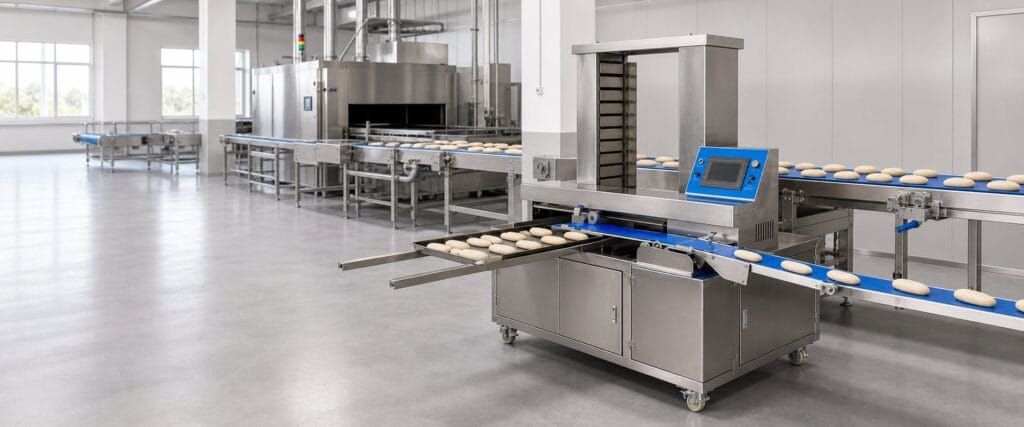
Producing pastries consistently involves much more than placing several machines next to each other. Dough must move through preparation, thickness control, cutting, forming, filling, and tray handling in a logical sequence, while every stage needs to deliver material in a condition that the next stage can process reliably.
This is the basic purpose of a pastry production line. Instead of treating each operation as an isolated task, the line connects multiple processing stages into a coordinated workflow. The result is not simply greater automation. A properly designed pastry production line can also improve dimensional consistency, reduce unnecessary material handling, stabilize production rhythm, and make process adjustments easier to manage.
However, different pastries require very different workflows. Tart shells, laminated pastries, filled products, cookies, and formed dough products may share certain processing stages, but the equipment sequence, dough conditions, filling methods, and transfer systems can vary considerably.
Understanding these differences is essential before designing an automated pastry production process.
What Is a Pastry Production Line?
A pastry production line is a coordinated system of machines and transfer stages used to convert prepared ingredients or dough into pastry products through a defined sequence of operations.
The general principle follows the concept of a production line, where individual processing stages are arranged in sequence so that material moves progressively toward the finished product.
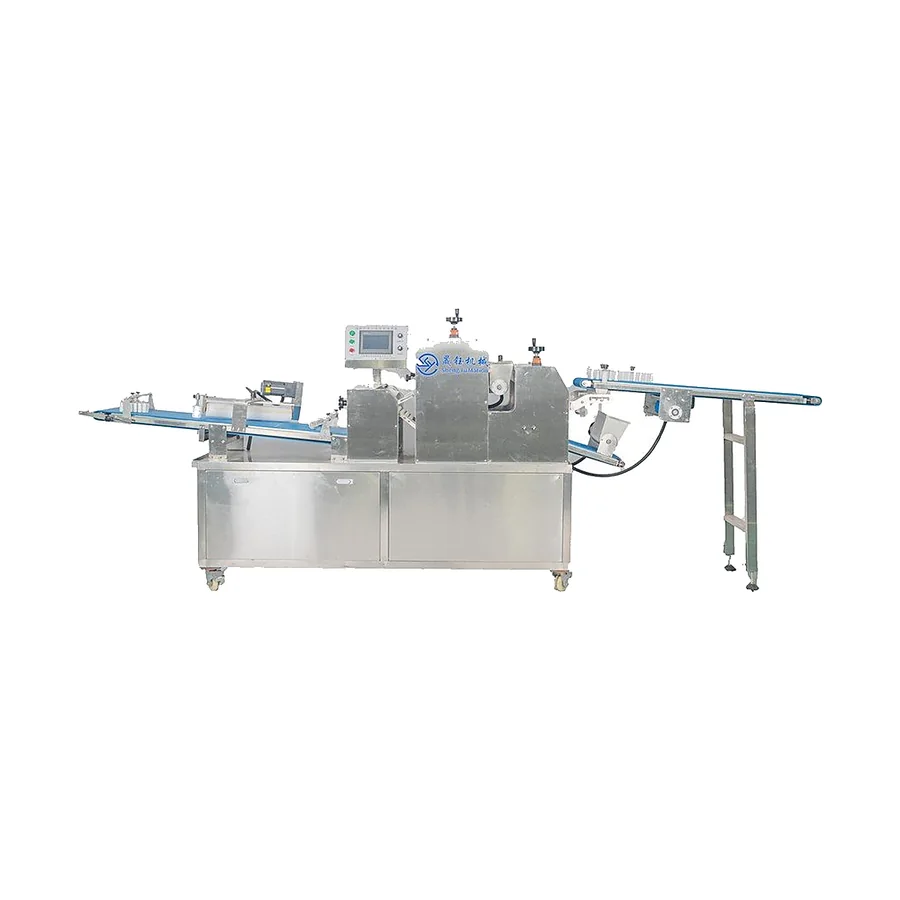
In pastry manufacturing, these operations may include dough feeding, rolling, sheeting, cutting, portioning, forming, filling, molding, conveying, and tray arranging. Some production lines include all of these stages, while others automate only the processes that create the greatest bottlenecks.
A pastry production line should therefore not be understood as one fixed machine configuration. It is better viewed as a production system designed around a specific pastry, dough structure, product size, forming method, and desired workflow.
For example, a tart shell line requires controlled dough preparation and forming, while a filled pastry line may place greater emphasis on portioning, filling accuracy, sealing, and shape control.
What Are the Main Stages of a Pastry Production Line?
Although pastry products differ, many automated lines can be divided into several basic processing stages.
The first stage is normally dough preparation or feeding. Dough must reach the processing equipment with suitable temperature, consistency, hydration, and dimensions. If dough condition changes significantly between batches, even accurately adjusted machinery may produce inconsistent results.
The second stage often involves thickness reduction or pre-forming. Dough may be flattened, rolled, or converted into sheets before further processing. This prepares the material for cutting and forming while creating more predictable dimensions.
The next stage depends heavily on the pastry. Dough may be cut into individual portions, pressed into molds, rolled into shapes, folded, laminated, or formed around a filling.
Filling equipment may then deposit custard, cream, paste, or another material according to the product design. Finally, the formed products may be transferred and positioned on baking trays before moving to later processes.
A typical flow can therefore look like:
Dough preparation → dough feeding → rolling or sheeting → cutting → forming → filling → tray arranging → baking preparation
The exact sequence should always follow the characteristics of the finished pastry rather than forcing different products into the same machine arrangement.
Why Dough Processing Is the Foundation of the Line
The quality of a pastry production line often depends on what happens before filling or final forming begins.
Dough is a variable material. Its behavior changes with formulation, moisture, temperature, resting time, mixing condition, and mechanical handling. A line designed without accounting for these factors may experience sticking, tearing, shrinking, irregular feeding, or uneven product dimensions.
For products produced from dough sheets, thickness control is particularly important. The dough entering a cutter or forming machine should be sufficiently uniform so that every portion begins with similar dimensions and material quantity.
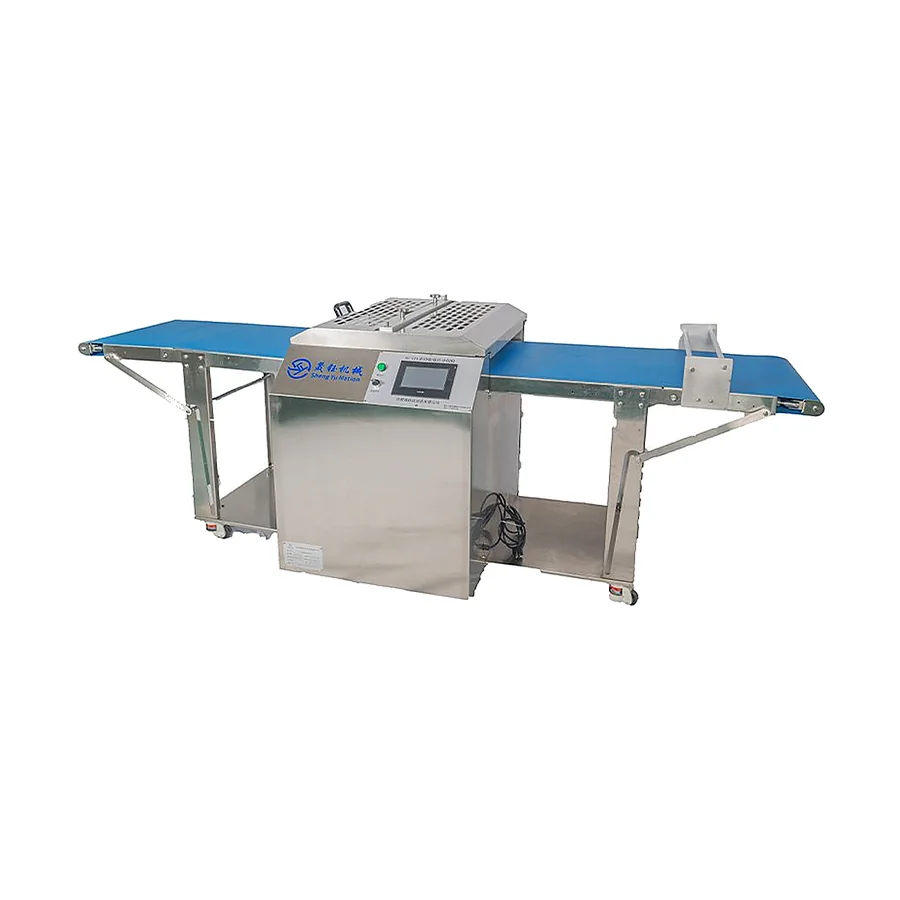
This is why dough processing machines often form the upstream foundation of a pastry line. Depending on the product, these stages may include rolling, sheet formation, cutting, dividing, or preliminary forming.
The objective is not simply to make dough thinner. The objective is to create a stable intermediate material that downstream equipment can handle repeatedly.
If the upstream process varies too much, later automation becomes less effective because cutters, molds, filling heads, and tray systems must continually compensate for irregular incoming products.
How Cutting and Forming Affect Product Consistency
Once dough reaches the correct size or thickness, it usually needs to be converted into individual portions or final shapes.
Cutting may appear to be a simple operation, but small dimensional differences can influence the forming process that follows. If dough pieces vary in width, length, or weight, they may not sit consistently inside molds or forming stations.
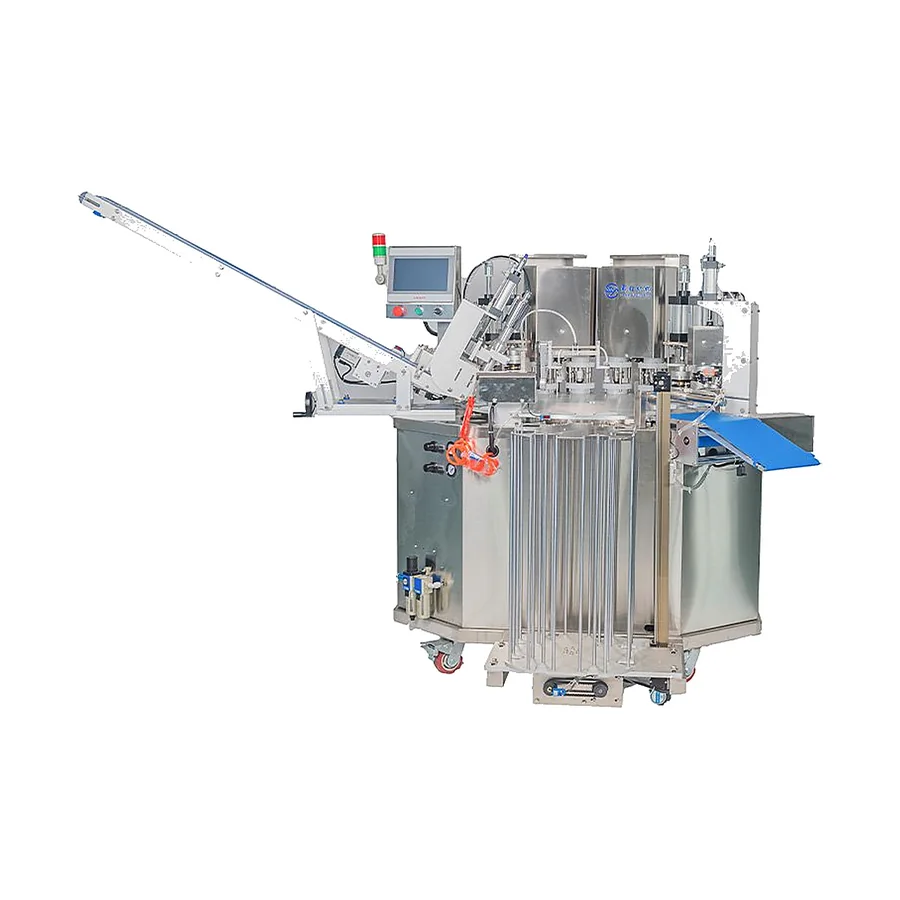
Forming then applies controlled mechanical movement to create the desired product geometry. Depending on the pastry, this could involve pressing dough into a tart mold, rolling dough around a filling, shaping a bread-like product, or creating decorative surface features.
A good pastry production line keeps the relationship between cutting and forming stable. The cut portion should contain enough dough for the forming process without creating unnecessary excess material.
Tooling is also important. Product dimensions, mold shape, dough elasticity, and required surface detail can influence how a forming station should operate.
When developing a new pastry, production trials are useful because the dimensions before forming are not always identical to the final dimensions after forming. Dough can stretch, compress, or recover after mechanical pressure is released.
Where Filling Equipment Fits Into Pastry Production
Many pastries contain custard, cream, fruit preparation, paste, or other fillings. Once filling becomes part of an automated process, portion consistency and timing become important.
The filling stage must synchronize with the arrival of each pastry shell or dough portion. If products arrive irregularly, the depositing process may become unstable even when the filling mechanism itself operates accurately.
The physical properties of the filling also matter. A smooth liquid behaves differently from a thick paste or material containing small particles. Filling equipment must therefore be matched to viscosity, required portion, product opening, and production rhythm.
Positioning is equally important. Filling deposited away from the intended center can interfere with later folding, sealing, or baking.
For this reason, a pastry production line should treat filling as part of the complete process instead of selecting a filling machine separately and attempting to connect it afterward.
The upstream forming stage, filling point, product spacing, and downstream transfer all need to work together.
Why Production Line Balance Matters
One of the most common mistakes in production planning is evaluating every machine only by its individual maximum output.
A pastry production line operates as a system. Its practical production rhythm is influenced by the interaction between all connected stages.
Consider a simplified example in which the dough processing stage can prepare 100 units during a given period, the forming stage can process 80, and the filling stage can handle 70. Increasing the dough processing stage to 120 does not make the whole production line operate at 120 because the downstream stages cannot maintain that rhythm.
Instead, excess material may begin accumulating before the slower operation.
The principle can be summarized as follows:
| Production Stage | Main Control Factor | Possible Effect of Poor Matching |
|---|---|---|
| Dough feeding | Stable material supply | Interrupted downstream operation |
| Sheeting or rolling | Thickness and feeding speed | Uneven dough dimensions |
| Cutting | Portion size and spacing | Irregular forming |
| Forming | Product shape and cycle timing | Upstream accumulation |
| Filling | Portion and synchronization | Overflow or uneven filling |
| Tray arranging | Product spacing and tray position | Delays at line output |
The goal is therefore not to maximize every individual machine independently. It is to create a balanced pastry production line in which each stage can support the required production rhythm.
How Conveying and Product Transfer Influence Line Performance
Transfer sections may receive less attention than forming or filling machines, but they have an important effect on overall process stability.
Pastry products can be soft, sticky, delicate, or easily deformed. Moving them between machines requires controlled transfer rather than simply increasing conveyor speed.
A large height difference between two sections can cause products to shift or lose shape. Excessive belt speed changes can alter spacing. Poorly aligned transfer points can also affect the position of dough pieces entering cutters, molds, or filling stations.
For continuous pastry production, spacing is particularly important. Downstream machines need to know when and where each product will arrive.
Transfer design should therefore consider:
product dimensions, dough softness, surface condition, machine height, belt speed, spacing requirements, transfer distance, and downstream positioning.
When these elements are planned together, the pastry production line becomes easier to synchronize.
What Role Does Tray Arranging Play?
Tray arranging is often one of the final automation stages before products move toward baking or another finishing process.
Manual tray placement may work effectively at lower production volumes, but it becomes more difficult to maintain uniform spacing as upstream forming speed increases.
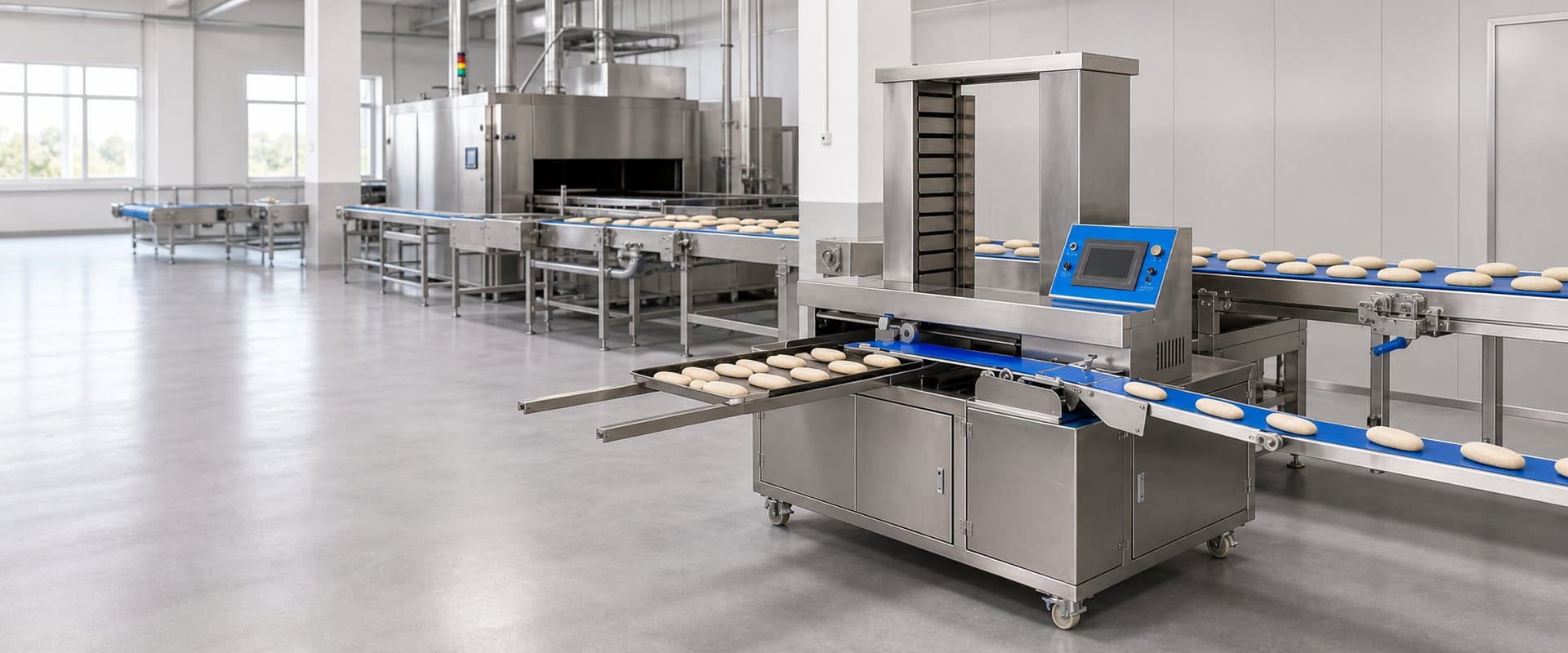
An automated system can receive individual products from the production conveyor and place them according to the required tray pattern. The correct arrangement depends on pastry dimensions, tray dimensions, baking expansion, and downstream handling requirements.
Tray arranging should not be treated simply as the final machine added to a pastry production line. Its operating rhythm must match the incoming product flow.
If the forming and filling stages produce items continuously while tray exchange creates frequent interruptions, products can accumulate at the end of the line. Buffering, timing control, or coordinated tray movement may therefore be necessary.
This illustrates an important principle of automation: improving one operation is useful only when the surrounding processes can support it.
How Automation Changes Pastry Production
Automation reduces reliance on repeated manual actions, but its greatest value comes from process repeatability.
During manual production, operators continually make small adjustments. They compensate for changing dough shape, estimate portions, change rolling pressure, reposition products, and adapt to production conditions.
These skills remain valuable, but they can be difficult to reproduce consistently across long production periods.
Automated machinery converts suitable parts of this knowledge into repeatable machine movements and settings. Roller gaps can be standardized, cutting dimensions can remain fixed, forming cycles can be controlled, and filling operations can follow a defined rhythm.
The objective is not to eliminate every human decision. Operators still need to monitor dough condition, production quality, sanitation, tooling, and equipment performance.
Instead, automation reduces repetitive variation so that operators can concentrate more on process control.
For ShengYu’s wider range of pastry-forming and processing configurations, the pastry production equipment range shows how individual machines can perform different roles within a connected production workflow.
How to Plan a Pastry Production Line for Different Products
A production line should begin with the finished pastry rather than with a list of available machines.
First, define the product dimensions and shape. Determine whether the pastry is flat, rolled, folded, molded, filled, or pressed into a container.
Next, examine the dough. Important characteristics include whether it is soft or firm, laminated or non-laminated, sticky or relatively dry, and whether it changes significantly with temperature.
The forming process should then be defined. Some pastries require cutting before forming, while others can be continuously shaped before individual portions are separated.
If filling is involved, its viscosity, portion, placement, and timing should be established.
Tray requirements also need to be considered early. Product spacing and tray dimensions can influence how the final transfer stage is configured.
Only after these factors are understood should individual machines be selected and positioned.
This product-first approach helps prevent a common problem: assembling equipment that performs well independently but does not create a smooth overall process.
What Should Be Considered Before Increasing Automation?
More automation is not automatically better for every production environment.
Before increasing automation, producers should identify the parts of the existing process that create the greatest variation, labor repetition, production interruption, or handling difficulty.
For one facility, dough thickness control may be the biggest problem. For another, forming may be stable while manual filling limits production continuity. A third operation may already have automated forming but experience delays during tray placement.
Automation should address these actual process constraints.
Product variety must also be considered. A facility producing one standardized pastry repeatedly may benefit from a highly dedicated line. A producer frequently changing product dimensions or styles may need greater flexibility in tooling and machine adjustment.
Available factory space also affects line configuration. Machines need sufficient room not only for production but also for operation, cleaning, inspection, material movement, and maintenance.
Planning these requirements before equipment installation usually produces a more practical pastry production line than attempting to adapt the surrounding production area afterward.
How to Improve Flexibility in a Pastry Production Line
Pastry producers often need to handle more than one product style. This means flexibility can be as important as automation level.
Adjustable settings can allow the same processing stage to accommodate different dough thicknesses or product dimensions within the mechanical range of the equipment.
Replaceable forming tools may support different product geometries. Filling adjustments can help accommodate different portion requirements, while conveyor settings can change spacing between products.
However, flexibility should be planned realistically.
A machine that can technically be adjusted to many settings does not necessarily mean every pastry can run through the same complete production line. Significant differences in dough behavior or forming method may require different equipment.
The most useful form of flexibility is therefore controlled flexibility: clearly defining which product families share similar processes and designing changeovers around those similarities.
Common Mistakes When Designing a Pastry Production Line
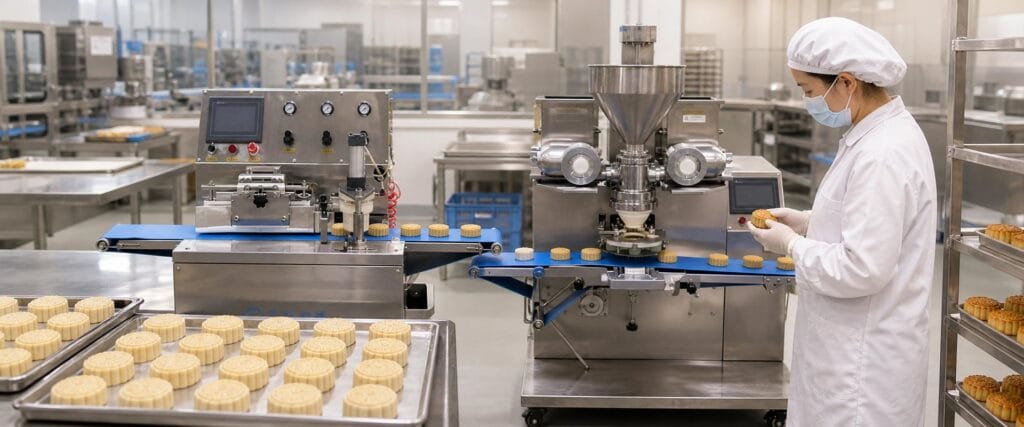
One mistake is focusing only on individual machine specifications without considering material flow between machines.
Another is selecting equipment before finalizing product dimensions. This can lead to later changes in molds, cutting tools, conveyors, or filling positions.
A third mistake is assuming that maximum machine output equals actual line output. Production should be evaluated as a connected system.
Ignoring cleaning access can also create practical problems. Food-processing equipment requires routine cleaning, and machines positioned too closely together may be difficult to access.
Manufacturers should also avoid overlooking future product changes. Even when the first production target is clearly defined, reasonable adjustability can make future process development easier.
Finally, insufficient production trials can leave important dough behavior undiscovered until after a line is configured. Testing the interaction between dough, tooling, filling, and transfer systems helps identify problems earlier.
Conclusion
A pastry production line is not simply a collection of automated machines. It is a coordinated processing system in which dough preparation, sheeting, cutting, forming, filling, transfer, and tray handling must work together.
Successful automation begins by understanding the finished product. Dough behavior, product dimensions, filling characteristics, production sequence, tray format, and available factory space all influence how the line should be arranged.
The most effective pastry production line is therefore not necessarily the one with the largest number of machines. It is the one in which each processing stage supports the next stage with stable material flow and predictable timing.
By designing the production process as a complete system, pastry manufacturers can create a stronger foundation for consistent products, repeatable operation, and future automation development.
FAQ
What equipment is included in a pastry production line?
The equipment depends on the pastry, but a line may include dough feeding, rolling or sheeting, cutting, forming, filling, conveying, and tray arranging equipment.
Does every pastry production line need a dough sheeter?
No. A dough sheeter is useful when the product requires controlled dough sheets, but pastries produced through other dividing or forming methods may use a different upstream process.
Can one pastry production line make different products?
Some lines can handle multiple related products through setting changes or replaceable tooling. Products with very different dough structures or forming methods may require different processing configurations.
Why is line balancing important in pastry production?
Line balancing helps connected machines operate at compatible production rhythms. If one stage works much slower than another, products or dough may accumulate and interrupt continuous processing.
What information is needed when planning a pastry production line?
Useful information includes pastry type, product dimensions, dough characteristics, filling type, forming method, desired production flow, tray dimensions, and available production space.